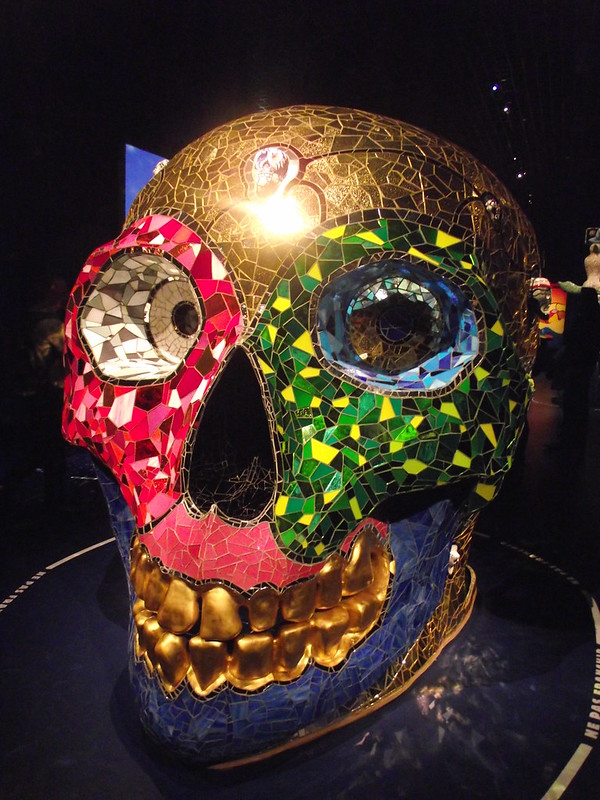
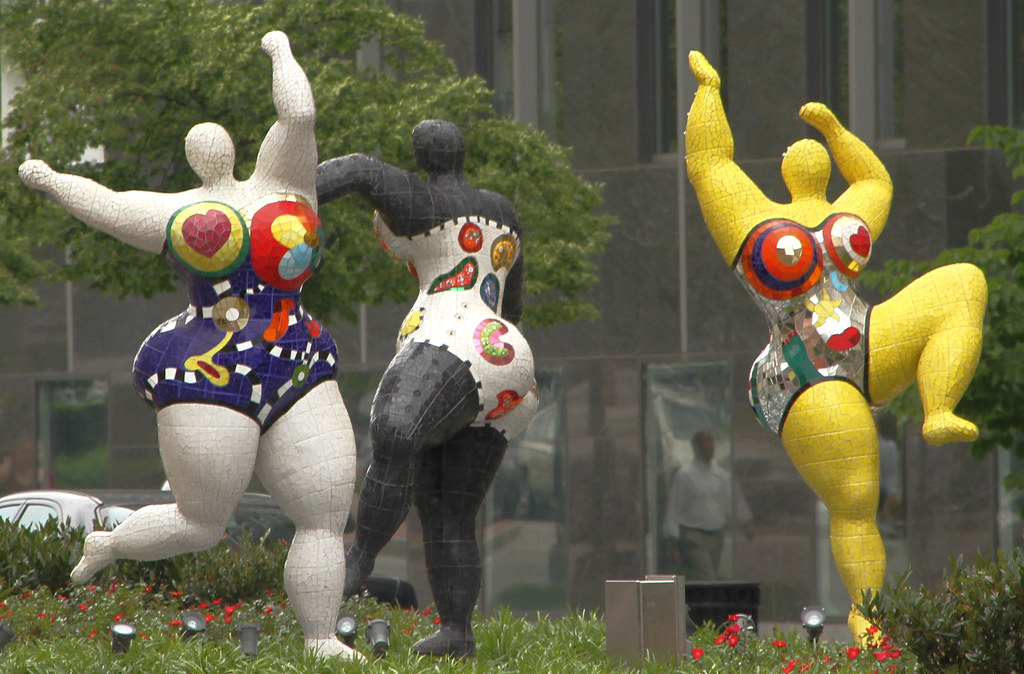
The most famous contemporary female figures of the second half of the 20th century belong to the sculptor of French origin, Niki de Saint Phalle.
Nana
Niki created her first sculpture, translated from French slang—"women, chick. "Nana made its first public appearance in 1965 at an exhibition at the Alexander Iolas Gallery in Paris. For the exhibition, a catalog of original drawings with her text, invitations, and posters was printed. Drawings accompanied by text and messages are a kind of manual preparation that becomes a recognizable sign of her exhibitions and an equal part of her artistic oeuvre.
Nana represents the archetype of the female figure, the goddess of fertility and dominance over men. She was inspired by the pregnancy of her friend Clarissa, the wife of sculptor Larry Rivers.
Nanas were huge, which was supposed to make men feel tiny and powerless - her symbolic response to the position of women in society.
It was a way of overcoming difficult experiences from her childhood, when her father sexually abused her, according to her confession. She revealed this traumatic event in her autobiographical book "Snake Summer" 50 years ago. At the age of 12, she came across two swirling serpents. She escaped them by good luck. After that event, the one with her father happened. Two snakes will become a constant motif in her sculptures and drawings. They are a reminder that danger is always lurking. She decided to deal with the memories of a difficult childhood by making positive, colorful, cheerful figures of strong women and mythological creatures from the imagination and heritage of indigenous peoples.
The largest sculpture of Nana was exhibited in front of the Modern Museum (Moderna Museet) in Stockholm in 1966. It was called "She - the cathedral". It was a reclining figure of a woman about 21m long, seen from the outside. Inside, it represented the gallery, which could be entered through the entrance between the legs. In the area below the breast, there was a bar that served milk. She worked on the exhibition in a team with her future husband, Jean Tinguely, and Per Olof Ultvedt.
Her park sculptures were of such dimensions that one could live or play inside them.
In those years, she began to produce inflatable Nanas in the form of balloons sold in the USA.
In addition to female figures, cheerful phantasmic beings are depicted in a similar artistic style. This work was developed following her trips to India and Egypt, which had a significant cultural impact.
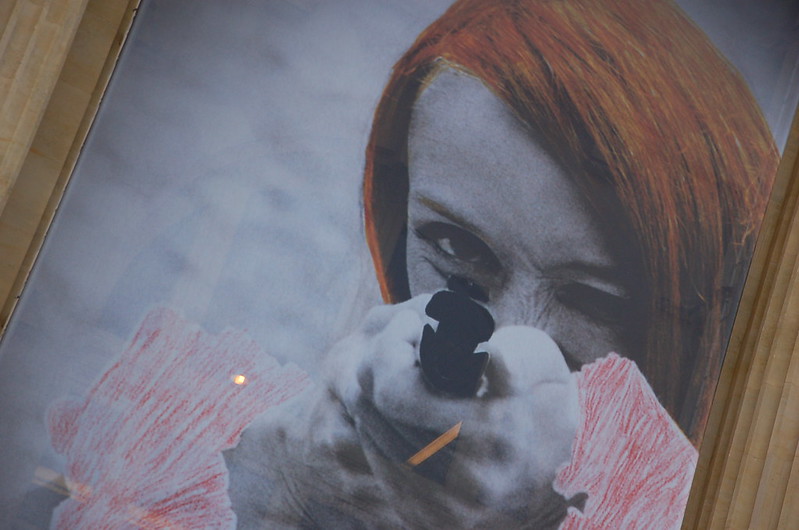
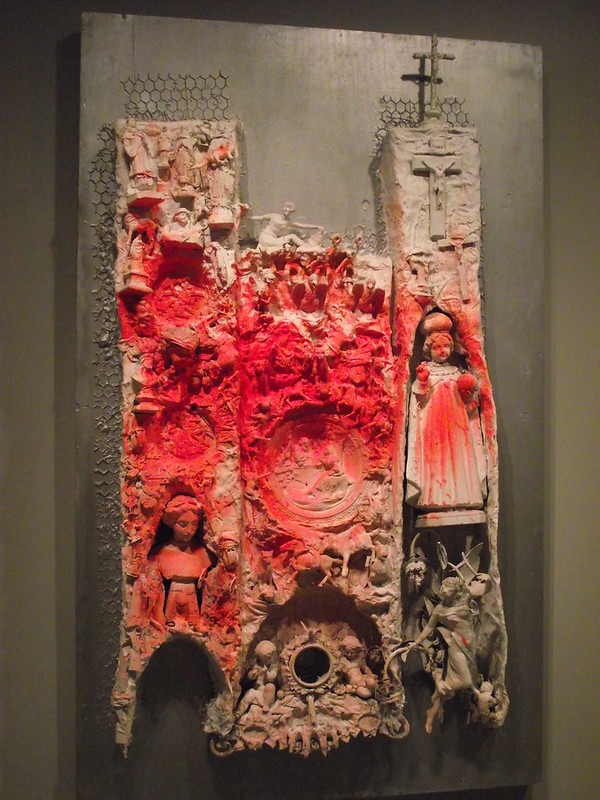
The Nana phase came after dealing with painful, tragic family experiences. The "Shots" cycle, in which other invited artists could also participate, consists of relief plaster paintings, with bags of paint placed on the back. Such installations were shot at during performances. She called the shots in Status Quo!
The results are completely out of the artist's control and are an expression of chance.
Several of the performances were broadcast live on television, demonstrating that Niki d'Saint Phall skillfully utilized the media. Given her background as a model who had previously graced the covers of French Vogue and Elle magazines, this strategic approach was well within her abilities. Additionally, it's worth noting that her initial aspiration was to study theater arts.
This series of paintings did not represent the love of weapons. On the contrary, through her role as an activist, she fought against its use and violence. In addition, she actively fought for the issues of climate change and helping people suffering from AIDS.
I thought it was necessary to provoke and attack religion and generals. And then I realized that there is nothing more shocking than joy.
— Niki de Saint Phalle
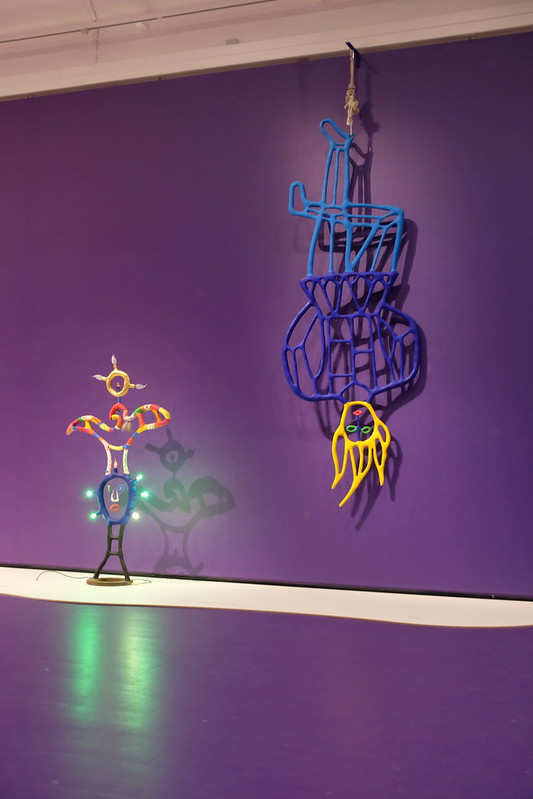
In 1979, Niki started a new cycle, "Skinnies", a linear sculpture, similar to modern totems. With her magic, she turned a colorful drawing into a sculpture. The colors here are also basic, and blue predominates. The sculpture of two twisted, colorful snakes was used for the first edition of her perfume. She established it to finance her grand life project - the Tarot Garden (1978-1998).
Snakes are her totemic animals, embodying the cycle of life. Nicky grew up surrounded by fantastic and mythological stories. Coming from an aristocratic family from one of the oldest families in France, she spent her earliest childhood in her grandmother's castle. Stories of chivalric battles and origins are woven into her fantastic world. In addition to this, she found inspiration in Greek, Egyptian, Sumerian, and pre-Columbian mythology and children's stories. All these influences create creatures of the imagination.
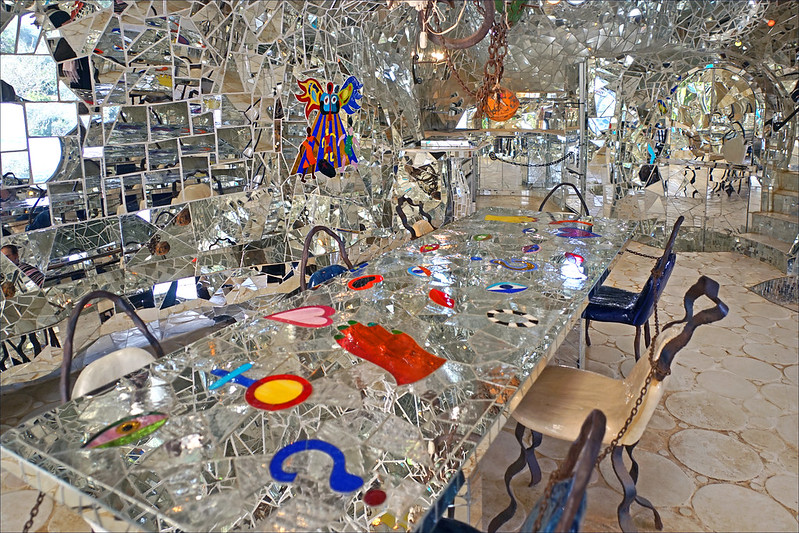
The 22 sculptures she created were inspired by Tarot cards. Located in southern Tuscany, near the medieval village of Garaviccio, a park has been established that spans an area of 5.6 hectares. This park is a tribute to Antonio Gaudí's Park Güell in Barcelona, incorporating his artistic techniques, such as broken glass mosaics, ceramics, and especially mirrors. The mirrors reflect the colors of the sculptures, causing them to change throughout the day according to the weather.
Tarot bašta, apartman u kom je živela Niki de Saint Phalle u toku gradnje parka
She lived in a spacious sculpture named "The Empress" for several years during the construction of the park. The photo shows the dining room, which, with its design of broken mirrors, is reminiscent of the empress's chambers from children's fairy tales.
The entrance to this phantasmic park, in the form of a massive wall with a round opening, was designed by a famous Swiss architect Mario Botta.
San Diego is the open gallery of Niki de Saint Phalle!
The famous Swiss sculptor Jean Tinguely was Niki's lifelong companion, collaborator, and a huge supporter of her talent without an official art degree. Together, they created a famous Stravinsky fountain in ParisPlace Igor Stravinsky Square in Paris, France 1983. In the same artistic manner, they received an order in 1989 for the Chateau Chinon Fountain (Chateau Chinon Fountain) in the place of the same name, on François Mitterrand Square.
After the death of her husband, Nikki moved from New York to San Diego, California. This city is her great outdoor exhibition gallery. Numerous individual sculptures, as well as the park complex, found their home here.
Magični krug Kraljice Kalifije je naziv poslednjeg parka njenih skulptura. Radjen je izmedju 2000 i 2003.g, a završen nakon njene smrti. Park je omaž kulturnom pluralizmu graničnog grada izmedju SAD i Meksika. Skulpture obradjuju teme tradicije urodjeničkih naroda Amerike, pretkolumbovske ere, te Kulta Majke Zemlje. Totemi iz meksičke kulture redizajnirani su i prevedeni na jezik Niki d'Sen Fal. Svet opasnih životinjskih vrsta preobraćen je u opuštenu družinu koja uveseljava raskošnom upotrebom boja.
After great traumas from her childhood, Niki spreads joy through her sculptures, cheers up, and invites children to play.
Architect by education. I am researching the theoretical foundations of the construction of modern buildings in the historic city core. Protection of historical heritage through revitalization - new life for old buildings.